

Daily Travel and CO2 Emissions from Passenger Transport: A Comparison of Germany and the United States

Introduction and Overview
Federal, state, and local governments in the United States and Germany aim to reduce petroleum use and associated greenhouse gas (GHG) emissions from transport. In 2010, the transport sector was responsible for 20 percent of GHG emissions in Germany compared to 31 percent in the U.S.[1] In both countries the vast majority (~95 percent) of energy for transport came from petroleum and carbon dioxide (CO2) accounted for about 95 percent of GHG emissions from transport.[2]
Automobiles, light trucks, and public transport were responsible for roughly two-thirds of transport GHG emissions in each country—accounting for 13.5 percent of total CO2 emissions in Germany and 22.7 percent in the U.S.[3] Annual per-capita CO2 emissions from ground passenger transport in the U.S. were three times greater than in Germany: 3,800 vs.1,200kg.[4] Even adjusting for economic activity, CO2 emissions from passenger transport per unit of gross domestic product (GDP) were 2.4 times greater in the U.S. than in Germany.
Tackling emissions from ground passenger transport has proven difficult, because improvements in technological efficiency of cars and fuels can be off-set by heavier vehicles, more powerful engines, and longer travel distances (the so-called “rebound effect”).[5] Compared to the energy and industry sectors, passenger transport emissions are more difficult to regulate, because travel behavior depends on individual decisions about residential location, vehicle ownership, transport mode choice, number of trips, and travel distance.[6]
This article first compares trends of CO2 emissions[7] from passenger transport in Germany and the U.S. since 1990. Next it discusses policies that can help decrease CO2 emissions from passenger transport through technology and changes in travel demand. The analysis concludes with policy lessons for both countries.
Many Similarities between Germany and the U.S.
Germany and the U.S. present many similarities that make a comparison of CO2 emissions from transport and related policies meaningful. Both are western democracies with market economies, a high standard of living, and federal systems of government in which the interaction between federal, state, and local governments shapes transport policies.[8] Both countries have large networks of limited access highways, a similar share of licensed drivers (70 percent) in the population, and an important automobile industry.[9] In both countries most suburban development occurred after World War II during periods of rapid motorization. In Germany and the U.S. the automobile is an important status symbol. Both countries have among the highest motorization rates in the world. However, compared to Germans, Americans own 30 percent more vehicles: 766 versus 585 cars and light trucks per 1,000 population.[10]
Trends in CO2 Emissions from Passenger Transport in Germany and the U.S.
Germany was more successful than the U.S. in reducing CO2 emissions from passenger transport over the last two decades (see Table 1). Between 1990 and 2010, total ground passenger transport CO2 emissions in Germany declined by 15 percent compared to a 12 percent increase in the U.S. CO2 emissions in the U.S. increased sharply between 1990 and 2005 (+21 percent) and then fell between 2005 and 2010. The drop in CO2 emissions between 2005 and 2010 is likely related to the economic crisis, volatile fuel prices, and consequently less driving. The U.S. Department of Transportation reports a sharp drop of 15 percent in passenger kilometers of car travel between 2006 and 2009.[11]
Adjusting for population size, per-capita CO2 emissions increased in the U.S. between 1990 and 2005, but declined between 2005 and 2010—resulting in 9 percent lower CO2 emissions per capita in 2010 compared to 1990. In Germany, per capita CO2 emissions declined by 17 percent between 1990 and 2010. Between 1990 and 2010, CO2 emissions per kilometer traveled declined by 20 percent in Germany but only 3 percent in the U.S.—reflecting a slower increase in driving demand and larger gains in vehicle fuel efficiency in Germany during this time. Compared to economic activity, measured in dollars of constant GDP, between 1990 and 2010 Germany decreased its CO2 emissions from passenger transport at a slightly faster rate than the U.S. (-36% versus -31%).
In summary, between 1990 and 2010 Germany reduced CO2 emissions from passenger transport at a faster rate than the U.S.—even controlling for population growth, economic activity, and travel demand. Moreover, for all indicators CO2 emissions from transport were much higher in the U.S. than in Germany.
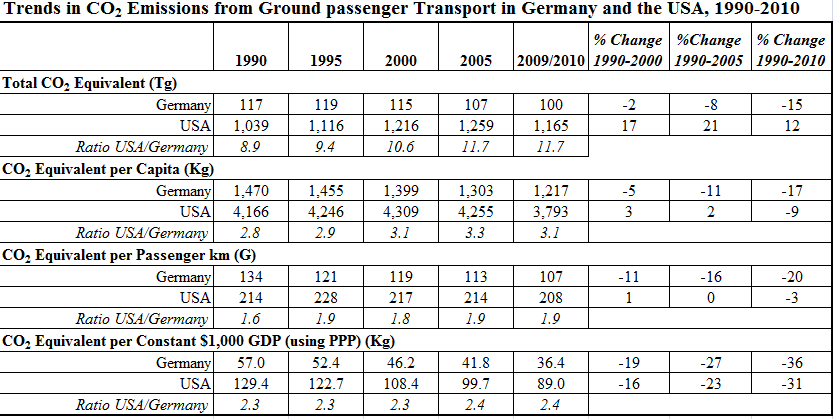
Sources: Environmental Protection Agency, CO2 Emissions from Fossil Fuel Combustion in Transportation End-Use Sector (Washington, DC: Environmental Protection Agency, 2012; OECD, OECD Factbook (Paris: Organization for Economic Cooperation and Development, 2012); Umweltbundesamt, CO2 Emissions from Passenger Transport (Dessau: Umweltbundesamt, 2012). Note: CO2 equivalent emissions are based on national fuel consumption estimates. The data do not capture “gray imports” due to refueling abroad.
Federal GHG Reduction Goals for Transport
Since ratifying the Kyoto Protocol Germany has set national targets for reducing GHG emissions. Between 1990 and 2010, Germany reduced its total GHG emissions by 22 percent and continues to strive to achieve a 40 percent reduction relative to 1990 by 2020.[12] Between 1990 and 2010, emissions from transport declined at a lower rate than those for industry and energy sectors. Achieving the overall 40 percent target by 2020, however, requires the transport sector to reduce its annual emissions by 20 to 25 percent between 2005 and 2020.[13]
There is no explicit federal policy to reduce GHGs in the U.S. However, since 2009 the Environmental Protection Agency (EPA) has regulated GHG emissions as air pollutants that endanger public health and welfare.[14] Moreover, twenty-three states had GHG reduction targets and thirty-seven states had climate action plans in 2012. GHG reduction targets vary by state. For example, California’s target is to achieve 1990 emission levels by 2020.[15]
In both countries federal governments have developed a number of policies that directly or indirectly reduce CO2 emissions from automobile transport including fuel economy and CO2 tailpipe emission standards, vehicle registration fees and taxes, incentive programs for the purchase of fuel efficient cars, biofuel standards, and gasoline taxes. Federal governments also support local and state policies that can help change travel demand by promoting public transport, walking, and cycling, as well as land-use policies that keep trip distances short.
Improved Technology
Fuel Efficiency and CO2 Emission Standards
The EU and the U.S. attempt to reduce GHG emissions from transport through vehicle fuel efficiency and/or CO2 emissions standards.[16] The two standards are treated interchangeably here, because the burning of fossil fuels is closely related to CO2 emissions. In 2010, the German automobile and light truck vehicle fleet was 45 percent more fuel efficient than the U.S. light duty vehicle fleet (35 vs. 24 mpg, 7.5 vs. 11.2 l/100km[17],[18]).
In 1975, the U.S. implemented the world’s first fuel economy standard for cars and light trucks, the Corporate Average Fuel Efficiency (CAFE) standards.[19] Between 1980 and 1991, the fuel efficiency of the U.S. light duty vehicle fleet increased from 16 mpg to 21 mpg.[20] Progress has been slower since then, reaching a fleet average of 24 mpg[21] in 2009. Decreasing gains in fuel efficiency are partially explained by the failure to raise CAFE standards for new passenger cars after reaching 27.5mpg[22] in 1985. Moreover, CAFE set lower fuel economy standards[23] for increasingly popular light trucks that surpassed the sales of passenger cars in 2002.[24]
Recently revised fuel economy standards apply to both passenger cars and light trucks (< 8,500 pounds).[25] The standards vary by vehicle-size,[26] requiring higher fuel efficiency for smaller than for larger vehicles. New light duty vehicles are set to average 30 mpg by 2015 and 39 mpg by 2020.[27] Because of the close connection of fuel efficiency and CO2 emissions, the new standards were developed in collaboration with the EPA,[28] which gained the authority to regulate GHG emissions under the Clean Air Act.[29] The mpg standards for 2015 and 2020 translate to 181 and 144 g CO2/km for new light duty vehicles.[30]
There are no fuel efficiency standards in Germany. Higher fuel efficiency is mostly explained by higher taxes on fuel and demand for more fuel efficient cars. However, more recently, German passenger cars have become subject to EU CO2 emission standards requiring manufacturers to achieve an average of 130 g CO2/km by 2015 and 95g CO2/km by 2020.[31] Similar to the revised standards in the U.S., EU standards vary by weight, with stricter standards for lighter than for heavier vehicles. Compared to the U.S., proposed EU standards for 2015 (130 vs. 181g) and 2020 (95 vs. 144g) are more stringent. However, the U.S. proposes to reduce CO2 emissions to 107g per km by 2025.
Incentives to Lower Pollution from Cars
Governments in both countries provide incentives for less polluting cars and fuels. For example, in 2009, Germany changed its formula to calculate annual vehicle registration fees for new cars to include CO2 emissions besides engine size and fuel type (diesel/gasoline)[32] of the vehicle.[33] The CO2 share of the tax is small and is calculated as €2 for each gram of CO2 emissions above a certain emissions threshold: 120g in 2009, 110g in 2012, and 95g in 2014. Electric vehicles are exempt from annual registration fees for five years.[34]
Vehicle registration fees in the U.S. vary by state.[35] However, the federal government has offered tax incentives for the purchase of alternative fuel vehicles, certain cars with diesel engines, hybrids, plug in hybrids, and electric vehicles. Incentives and program structures vary, but can be as high as $7,500 in federal tax credits for electric vehicles and plug-in hybrids. In 2012, all but twelve states offered additional incentive programs for hybrid electric vehicles and plug-in hybrids.[36]
During the economic crisis of 2008/2009, federal governments in Germany and the U.S. sought to support their automobile industries through monetary incentives for new car purchases if buyers turned in their old vehicles (better known as “Cash for Clunkers”). In both countries older, less fuel efficient vehicles were replaced with more fuel efficient newer vehicles with lower CO2 emissions per km. But the volume of new vehicles was too small to significantly reduce CO2 emissions from passenger transport.[37]
Both countries support the development of alternative fuels and alternative fuel vehicles including biodiesel, electricity, hydrogen, natural gas, and ethanol. The U.S. has a longer history of experimenting with and using alternative fuels. For example, a 10 percent share of ethanol in gasoline (E-10) is common in the U.S. But in 2011, the German government experienced a public relations disaster and public resistance when attempting to increase the ethanol content of gasoline from 5 to 10 percent. Many Germans believe that E-10 would destroy their vehicles.
Travel Behavior and Federal Policies
More CO2 emissions from passenger transport in the U.S. can be partly explained by the lower fuel efficiency of the U.S. vehicle fleet discussed above. However, more trips by automobile and longer travel distances are important factors as well. Americans drive almost twice as many miles per year as Germans (13,500 vs. 6,800 passenger miles of car travel). The automobile also accounts for a much higher share of trips in the U.S. than in Germany (86% vs. 58% of daily trips). By contrast, compared to Americans, Germans make a 4.5 times higher share of trips by public transport (9% vs. 2% of trips), 10 times more likely to ride a bicycle (10% vs. 1% of trips), and 2.2 times more likely to walk (24% vs. 11% of trips).
Longer average trip distances in the U.S. (9.8 miles) than in Germany (7.0 miles) do not fully explain different driving rates. For example, in both countries a similar share of all trips (32% in Germany and 27% in the U.S.) is shorter than 1 mile. However, Americans drive for 65 percent of these short trips compared to only 28 percent of Germans.
Average population densities are higher in German cities than in the U.S. However, even controlling for population density Germans are more likely to walk, cycle, and ride public transport. Americans living in dense, mixed-use areas, and close to public transport are even more likely to drive than Germans living in lower density areas, with more limited mix of land-uses, and farther from public transport.
Public policies at federal, state, and local levels of government help explain differences in car use. The following provides a short overview of German federal government policies that make car use less attractive and help promote walking, cycling, and public transport. The summary is based on previous publications by the author.[38]
Gasoline Taxes and Funding for Roads
In 2010, the cost of one liter of gasoline (95 RON unleaded) was $1.75 in Germany compared to $0.74 in the U.S.[39] Most of the difference was due to an eight times higher gas tax in Germany compared to the U.S. In 2010, taxes accounted for 62 percent of the retail price of gasoline in Germany compared to only 18 percent in the U.S.
The difference in gasoline retail price between Germany and the U.S. has been increasing. In 1986 gasoline cost about 80 percent more in Germany than the U.S. In 2010, the price of gas was 2.4 times higher in Germany. This divergence is partly explained by Germany’s environmental tax reform that increased gasoline taxes annually by €0.03 per liter ($0.14 per gallon) between 1998 and 2003—totaling €0.15 per liter ($0.71 per gallon) over five years. The tax was designed to curb energy use from transport and to encourage more fuel efficient cars and less driving. The policy of annual increases expired in 2003, but the five-year implementation of the environmental tax helped boost gas taxes and prices permanently. By contrast, federal gasoline taxes in the U.S. have not been raised since the early 1990s.
Revenue from highway user taxes and fees in Germany was 2.2 times higher than government road spending in 2010. By contrast, highway users receive net subsidies in the U.S. In 2009, highway user revenue collected by federal, state, and local governments in the U.S. covered only 58 percent of highways spending by all levels of government. Moreover, since 2008 the federal Highway Trust Fund, which receives the revenues from the federal gas tax, has been supplemented with general funds several times.
Higher gasoline taxes in Germany do not lead to higher household expenditures for transport in Germany. In fact, U.S. households spend about $2,500 more per year on transport—with transportation accounting for 17 percent of household expenditures in the U.S. compared to less than 15 percent in Germany.
On the local level, most German cities have increased the cost and/or reduced car parking in city centers and many neighborhoods. In the U.S., the vast majority of automobile trips (95 percent) are still subsidized with free car parking. Driving is also slower in German cities. In contrast to the U.S., limited access highways in Germany rarely penetrate cities and city centers. In the U.S., the federal government subsidized the construction of limited access highways in most American cities with a 90 percent federal share. The lack of high-speed highways in cities, combined with widespread traffic calming of residential neighborhoods, restricts car travel and makes it slower in German cities. Most German cities, including large cities like Berlin and Munch, have traffic calmed over 70 percent of their road network to speeds of 30km/h (19 mph) or even walking speed (7km/h or 4mph).
Tolling passenger cars for stretches of highways and for newly added lanes, bridges, and tunnels has been more common in the U.S. than in Germany. Trucks are tolled on the German Autobahn, but there is no charge for passenger cars. Moreover, the German Autobahn network still has many stretches without speed limits, compared to speed limits between 65 and 75mph on the U.S. interstate system in most states.
Walking and Cycling
The German federal government plays a minor role in promoting walking and cycling—mainly limited to federal traffic laws protecting cyclists and pedestrians and making their safety an integral part of the German driver’s license test. Most innovations, such as car-free pedestrian zones, area-wide traffic calming, integrated city-wide bicycling networks, bicycling training courses for school children, and pedestrian-activated traffic signals, were pioneered and implemented at the local and state level. The German federal government supported these efforts with technical guidance and flexible funding mechanisms, which allowed municipalities to use federal funds for non-motorized modes.
Since the 1990s, the U.S. federal government has provided an increasing amount of federal funds that can be used for walking and cycling projects on the local and metropolitan levels. Some U.S. cities have used this opportunity to promote walking and cycling. However, most U.S. cities still lack integrated networks of bike paths and lanes. Moreover, many suburban settlements in the U.S. do not have sidewalks or crosswalks for pedestrians. Driver’s training in the U.S. does not emphasize the rights of pedestrians and cyclists. Even though some cities have made progress, the U.S. is still less bike and pedestrian friendly than Germany. For example, in 2010, cyclist and pedestrian fatality rates per km cycled or walked were four to five times greater in the U.S. than in Germany.
Public Transport
Germans make 6.5 times as many public transport trips per year as Americans (135 vs. 21 trips per person per year). More attractive public transport in Germany can be explained by regional integration of public transport services, multi-modal coordination with other modes of transport, region-wide fare integration across transit operators, steeply discounted monthly and annual tickets, unified user information systems, real-time information at transit stations and on board vehicles, as well as traffic priority for buses and light rail.
In the U.S., the majority of public transport trips is concentrated in large cities with subway systems and regional rail, such as New York City, Boston, Philadelphia, Washington, Chicago, or San Francisco. Moreover, public transport service in suburban areas and many cities typically focuses on commuter hours with service going toward downtown in the morning and return services in the late afternoon. Even though many transit systems have made progress during the last decades, regional integration of timetables and ticketing, steeply discounted monthly tickets, and real-time passenger information are still rare or non-existent in the U.S. Even with the steeply discounted tickets and more service, German governments subsidize public transport at a lower rate than U.S. governments. In 2010, only 25 percent of public transport operating costs was subsidized in Germany, compared to a 65 percent subsidy share in the U.S.
Land-Use Planning
Federal involvement in land-use planning in Germany is limited to defining the legal framework for planning, ensuring consistency of planning techniques, and—in collaboration with the states—setting broad strategic goals for spatial development, such as sustainability. Municipal governments draw up the actual land-use plans and decide where different land uses are permitted. Local plans in Germany are restricted by regional and state plans—which are drawn up with the involvement of lower levels of government. Moreover, land-use plans must be coordinated with other sectors (e.g., transport) and neighboring jurisdictions.
By contrast, land-use planning in the U.S. is typically in the domain of municipalities, rarely coordinated across jurisdictions, and typically not integrated with transport planning. Additionally, mixed land use and dense development typically require changes to existing zoning codes in the U.S. German land-use planning is more flexible, because “residential zones” allow for doctor’s offices, small shops, restaurants, and multi-family housing. In the U.S., areas zoned as “single family residential” ban any mixed land uses or multi-family homes. German zoning typically applies to small areas (one block or a couple of blocks), while zones in the U.S. are usually much larger. Fine-grained zoning in Germany allows for a better mix of land uses that results in shorter trip distances.
Conclusion
CO2 emissions from transport are much higher in the U.S. than in Germany, even when controlling for population, economic activity, and travel distance. Between 1990 and 2010, Germany has reduced CO2 emissions from ground passenger transportation. Passenger transport CO2 emissions per capita and per km of travel have also declined in the U.S., but only between 2005 and 2010 during the economic crisis and volatile fuel prices.
Both countries attempt to improve the fuel efficiency of their vehicle fleet using CO2 tailpipe emission standards and incentives for less polluting vehicles and fuels. The U.S. has a longer history of fuel efficiency standards dating back to the 1980s. However, as the U.S. experience shows, policies focusing on technological improvements alone will not be enough to reduce CO2 emissions from transport, because of the potential rebound effect of heavier vehicles, larger engines, and increasing travel demand. Germany’s experience shows that public policies can help reduce car travel demand and make walking, cycling, and public transport attractive modes of transport. The most important lesson from Germany is the package of policies that restricts car use in cities and makes it more expensive while at the same time improves other modes of transport. Large subsidies for driving in the U.S. still make the automobile the most attractive option for the vast majority of trips. Reducing subsidies for driving, increasing its cost, and planning for walking, cycling, and public transport will take time, but promises lasting impact in both countries.
Dr. Ralph Buehler was a DAAD/AGI Fellows in July and August 2012. He is Assistant Professor in Urban Affairs and Planning at the School of Public and International Affairs Virginia Tech, Alexandria Center.
The author would like to thank Sebastian Beckmann, Carole Cook, Jessica Cuy, Venu Ghanta, Günter Hörmandinger, Nicholas Iaquino, Arne Jungjohann, Dominika Kalinowska, Uwe Kunert, Will Mallett, Georg Maue, Michael Mehling, Peter Mock, Bob Noland, Helge Pols, and Nadja Richter.
[1] Environmental Protection Agency, CO2 Emissions from Fossil Fuel Combustion in Transportation End-Use Sector (Washington, DC: Environmental Protection Agency, 2012); Umweltbundesamt, CO2 Emissions from Passenger Transport (Dessau: Umweltbundesamt, 2012).
[2] Ibid.
[3] Ibid.
[4] Ibid. Compared to other sectors (CO2 emissions from fuel combustion in kg per capita per year): electricity and heat 7,100 U.S. vs. 3,800 Germany; industry: 2,600 U.S. vs. 1,500 Germany; residential 1,000 U.S. vs. 1,400 Germany; other 900 U.S. vs. 700 Germany; total (including ground passenger, freight, and air transport): 17,000 U.S. vs. 9,200 Germany. See International Energy Agency, CO2 Emissions from Fuel Combustion: 1971-2009. (Paris: International Energy Agency, 2012).
[5] EMBARQ, Automobile Fuel; Economy and CO2 Emissions in Industrialized Countries: Troubling Trends through 2005/6 (Washington, DC: World Resources Institute, 2007).
[6] D.L. Greene, “Transportation and energy,” in The geography of urban transportation, ed. S. Hanson and G. Giuliano (New York: Guilford Publications, 2004); IPCC, Climate Change 2007 Synthesis Report (Geneva: Intergovernmental Panel on Climate Change UNEP, 2007).
[7] Reporting statistics on “CO2 equivalent” emissions—a measure that also accounts for other GHGs, such as CH4 and N20.
[8] B. Wentzel and D. Wentzel, Wirtschaftlicher Systemvergleich Deutschland/USA (Stuttgart: Lucius & Lucius Verlagsgesellschaft, 2000).
[9] Ralph Buehler, “Transport Policies, Automobile Use, and Sustainable Transport: A Comparison of Germany and the United States,” Journal of Planning Education and Research 30 (September 2010), 76-93.
[10] BMVBS, Verkehr in Zahlen. German transport in figures (Berlin: German Federal Ministry of Transportation and Urban Development, 1991-2012); USDOT, Transportation Statistics (Washington, DC: U.S. Department of Transportation, Federal Highway Administration, 2000-2012).
[11] USDOT, Transportation Statistics (Washington, DC: U.S. Department of Transportation, Federal Highway Administration, 2000-2012).
[12] Umweltbundesamt, CO2-Emissionsminderung im Verkehr in Deutschland (Dessau: Umweltbundesamt, 2010).
[13] Ibid.
[14] Transportation Research Board of the National Academies, Climate Change and Transportation. Circular E-C164 (Washington, DC: National Academies, 2012).
[15] PewCenter/C2ES, Climate Change 101: State Action (Arlington, VA: Pew Center/Center for Climate and Energy Solutions, 2011).
[16] International Council on Clean Transportation, A Review and Comparative Analysis of Fiscal Policies Associated with New Passenger Vehicle CO2 Emissions (Washington, DC: International Council on Clean Transportation, 2011); Transportation Research Board of the National Academies, Climate Change and Transportation. Circular E-C164 (Washington, DC: National Academies, 2012).
[17] MPG value based on U.S. CAFE testing cycle; l/100km value based on NEDC testing cycle. Using the ICCT conversion tool.
[18] Greater fuel economy is partly explained by a higher share of more fuel efficient cars with diesel engines in the German vehicle fleet. In fact, due to better fuel economy and lower taxation of diesel fuel, the share of cars with diesel has been increasing in Germany, a process known as “Dieselization.” Diesel engines are more fuel efficient, but contribute more to air pollution than gasoline powered cars. See EMBARQ, Automobile Fuel; Economy and CO2 Emissions in Industrialized Countries: Troubling Trends through 2005/6 (Washingotn, DC: World Resources Institute, 2007).
[19] United Nations, Global Overview on Fuel Efficiency and Motor Vehicle Emission Standards: Policy Options and Perspectives for International Cooperation (New York: The Innovation Center for Energy and Transportation, 2011).
[20] 17 to 13 l/100km
[21] 11 l/100km
[22] 9.7 l/100km
[23] 20.7mpg or 13.2 l/100km
[24] Oak Ridge National Laboratories, 2005-2012. Transportation Energy Data Book, 26 ed. (Oak Ridge: U.S. Department of Energy, 2005-2012).
[25] Congressional Budget Office, 2008. Climate Change Policy and CO2 Emissions from Passenger Vehicles (Washington, DC: Congressional Budget Office, 2008); Congressional Research Service, 2010. Car, Trucks, and Climate: EPA Regulations of Greenhouse Gases from Mobile Sources (Washington, DC: Congressional Research Service, 2010).
[26]The product of track width and wheelbase (i.e., distance between wheels on same axle and distance between front and rear axle).
[27] 8.8 l/100km by 2015 and 6.6 l per 100km by 2020; National Highway Traffic Safety Administraion (NHTSA), NHTSA and EPA Propose to Extend the National Program to Improve Fuel Economy and Greenhouse Gases for Passenger Cars and Light Trucks (Washington, DC: U.S. Department of Transportation, 2012).
[28] And the State of California and major car manufacturers.
[29] Congressional Research Service, 2010. Car, Trucks, and Climate: EPA Regulations of Greenhouse Gases from Mobile Sources (Washington, DC: Congressional Research Service, 2010).
[30] Based on NEDC.
[31] European Commission, CO2 Emission Standards (Brussels: European Commission, 2012); International Council on Clean Transportation, European CO2 Emission Performance Standards for Passenger Cars and Light Commercial Vehicles (Washington, DC: International Council on Clean Transportation, 2012).
[32] Registration fees for diesel passenger cars a higher to help offset lower gasoline taxes on diesel.
[33] €2 per 100 cubic centimeter (cc) for gasoline engines; €9.5 per 100 cc for diesel engines.
[34] German Institute for Economic Research (DIW), CO2-Besteuerung von Pkws in Europa auf dem Vormarsch (Berlin: DIW, 2009).
[35] Alternative Fuels Data Center, Alternative Fuels and Incentives (Washington, DC: U.S. Department of Energy, 2012).
[36] Oak Ridge National Laboratories, 2005-2012. Transportation Energy Data Book, 26 ed. (Oak Ridge: U.S. Department of Energy, 2005-2012).
[37] BAFA, Umweltpraemie (Berlin: Bundesamt für Wirtschaft und Ausfuhrkontrolle, 2010); National Highway Traffic Safety Administration (NHTSA), Consumer Assistance to Recycle and Save (CARS) Program (Washington, DC: U.S. Department of Transportation, 2010).
[38] Readers can access those publications and detailed information about state and local government policies here (http://ralphbu.wordpress.com/articles/sustainable-transport-policy).
[39] In Germany taxes on diesel fuel are lower than on gasoline. The difference was justified with the intent to support business and industry that rely on light and heavy trucks with diesel engines. To partially offset lower taxes on diesel fuel, annual vehicle registration fees are higher for passenger cars with diesel engines (see section above).